Why Do I Overthink Everything? The Hidden Need for Emotional Safety
Do you find yourself replaying conversations, second-guessing decisions, or searching for the "right" answer? In this article, we explore why overthinking often has less to do with finding clarity and more to do with seeking emotional safety—and how learning to trust yourself can help you step out of the spiral..
Lisa J Buhman
6/19/20267 min read
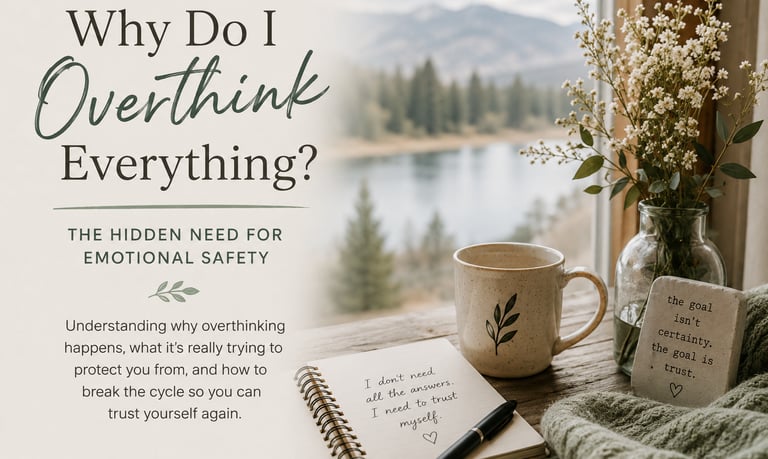
Why Do I Overthink Everything
If you tend to overthink things, you've probably asked yourself at some point:
"Why can't I just make a decision and let it go?"
Instead, your mind keeps going.
You replay the conversation.
You think about what might happen.
You imagine every possible outcome.
And after all that thinking, you often feel more confused than when you started.
For years, I thought overthinking meant I didn't have enough information yet. That if I just thought about it a little longer, I'd finally find the right answer.
What I've learned is that overthinking is often less about finding the right answer and more about trying to feel safe.
Emotionally safe.
Safe from making a mistake.
Safe from someone being upset.
Safe from getting it wrong.
IN THIS ARTICLE
What Is Overthinking Really?
Why Do We Overthink?
What Is Emotional Safety?
How Overthinking Creates More Doubt
What Overthinking Costs Us
Why The Goal Isn't Certainty
How To Begin Stepping Out Of The Spiral
What Is Overthinking Really?
I think a lot of people believe overthinking means they haven't figured it out yet.
But in my experience, that's often not true.
Many women have already noticed what feels right.
They've already noticed what feels off.
They already have an answer somewhere inside them.
Then doubt shows up.
Then fear shows up.
And suddenly what felt clear doesn't feel quite so clear anymore.
So they keep thinking.
And rethinking.
And looking at it from every angle.
Not because they're incapable of making a decision.
But because they're trying to feel certain about something that may never come with complete certainty.
And the longer we stay in that cycle, the harder it becomes to hear our own voice.
Why Do We Overthink?
I think a lot of people believe they're overthinking because they don't have enough information yet.
But in my experience, that's often not what's happening.
Most overthinking starts because we're trying to feel safe.
Usually, we don't even realize that's what we're doing.
Somewhere along the way, many of us learned that if we think hard enough, plan carefully enough, or consider every possible outcome, we'll be able to avoid making a mistake.
We'll keep someone from being upset.
We'll avoid disappointment.
We'll know exactly what to do.
So we keep thinking.
We replay the conversation.
We go over every possible scenario.
We try to see it from everyone else's perspective.
We look for one more piece of information or one more opinion.
Because maybe then we'll finally feel certain.
The problem is that life doesn't offer much certainty.
Most decisions don't come with guarantees.
We can't control how other people react.
We can't prevent every disappointment.
And there is no amount of thinking that completely protects us from uncertainty.
At some point, the goal has to shift.
Instead of asking, "How do I become certain?"
The question becomes, "How do I trust myself enough to move forward even when I'm not?"
What Is Emotional Safety?
Emotional safety is feeling like you can express your thoughts, feelings, ideas, and needs without worrying that someone is going to overreact, get angry, criticize you, dismiss you, or make you feel bad for having them.
The interesting thing is that many women didn't grow up feeling emotionally safe all the time.
Maybe a parent overreacted.
Maybe someone got angry when you expressed your feelings.
Maybe sharing your thoughts led to conflict or criticism.
Maybe keeping the peace felt easier than speaking up.
So somewhere along the way, you learned to pay attention to other people's reactions.
You learned to read the room.
To think ahead.
To anticipate problems before they happened.
To consider every possible outcome.
And honestly, it makes sense.
If you've had experiences where expressing yourself didn't feel safe, of course your mind would try to protect you.
Over time, thinking can start to feel like protection.
If I think about this long enough, maybe I can avoid upsetting someone.
Maybe I can prevent conflict.
Maybe I can make sure I say or do the right thing.
Not because you're broken.
Not because something is wrong with you.
But because your mind learned that being prepared felt safer than being caught off guard.
How Overthinking Creates More Doubt
One of the frustrating things about overthinking is that it often creates the very uncertainty we're trying to get rid of.
You start with a reasonable question.
Or maybe you already know what you want to do, but you're feeling a little unsure.
So you think about it.
Then you think about it some more.
You look at it from every angle.
You imagine all the possible outcomes.
You wonder if you're missing something.
You start questioning your decision.
Then you start questioning yourself.
Then you ask someone else what they think.
And maybe another person.
And another.
Before long, you've heard so many opinions and considered so many possibilities that your own voice gets harder to hear.
I think a lot of women have had the experience of knowing something felt right or knowing something felt off, and then overthinking it until they don't know what they think anymore.
Not because they didn't have an answer.
But because they stayed in their heads so long that they started doubting what they already noticed.
Overthinking promises clarity.
But a lot of the time, it creates confusion instead.
And the longer we stay in that cycle, the easier it becomes to trust everyone else's opinions more than our own.
What Overthinking Costs Us
Overthinking costs a lot more than time.
It doesn't just keep us thinking.
It keeps us carrying something around that was never meant to take up so much space.
It takes energy.
It steals peace.
It affects our confidence because the more we question ourselves, the harder it becomes to trust our own decisions.
It can affect our sleep.
It can affect our relationships.
And sometimes it can even affect us physically.
A lot of women know what it's like to have an upset stomach before a difficult conversation.
To replay something in their mind so many times that they're mentally exhausted.
To spend days carrying around the same thought and still not feel any closer to an answer.
And sometimes the cost is even bigger.
Missed opportunities.
Decisions that never get made.
Relationships that stay stuck.
Dreams that remain in the planning stage.
I can see this in my own life.
I knew for years that I wanted to do something like this. I wanted to help women reconnect with themselves and trust their own voice again.
But I kept researching.
I kept planning.
I kept taking another class.
I kept telling myself I just needed a little more information.
A little more knowledge.
A little more certainty.
Years went by that way.
Eventually, I realized I wasn't gathering information anymore.
I was looking for certainty.
And certainty never arrived.
At some point, I had to accept that there wasn't going to be one more class, one more piece of information, or one more answer that suddenly made me feel completely ready.
I had to trust myself enough to begin.
I think that's true for a lot of us.
Sometimes overthinking doesn't protect us.
Sometimes it simply keeps us waiting for a certainty that was never coming.
Why The Goal Isn't Certainty
One of the most important things I've learned is this:
The goal isn't certainty.
The goal is learning to trust yourself.
I think a lot of women believe that if they just think about something long enough, they'll eventually reach a place where they know for sure.
For sure this relationship will work.
For sure this conversation will go well.
For sure this decision is the right one.
But life doesn't offer many guarantees.
Most meaningful decisions come with some amount of unknown.
You don't know exactly how a relationship will turn out.
You don't know exactly how a business will turn out.
You don't know exactly how someone else is going to respond.
And honestly, that's uncomfortable.
Most of us don't like not knowing.
But waiting until you feel completely certain often means waiting a very long time.
Sometimes forever.
At some point, there has to be a shift.
Instead of asking, "How can I know for sure?"
The question becomes, "Do I trust myself enough to take the next step even though I don't know exactly how this will turn out?"
Because self-trust isn't having all the answers.
It's trusting that you'll be able to handle what comes next.
It's trusting that you'll learn what you need to learn.
It's trusting that even if things don't go exactly the way you hoped, you'll figure it out.
That's where self-trust begins to grow.
Not in certainty.
But in the willingness to move forward anyway.
How To Begin Stepping Out Of The Spiral
I think the first step is simply noticing what you're trying to accomplish by continuing to think about something.
Because sometimes we really are gathering information.
And sometimes we're looking for certainty.
Those aren't the same thing.
The next time you catch yourself replaying something over and over, try asking yourself:
"What am I hoping happens if I keep thinking about this?"
Am I trying to understand something better?
Or am I trying to guarantee an outcome?
Am I trying to solve a problem?
Or am I trying to make sure nobody gets upset?
Am I looking for information?
Or am I looking for certainty?
Just asking those questions can be incredibly helpful.
Because awareness is often where the spiral starts to loosen.
Not because you force yourself to stop thinking.
But because you begin to recognize what your mind is actually trying to do.
And honestly, that makes sense.
Most of us aren't overthinking because we're trying to make ourselves miserable.
We're overthinking because some part of us is trying to feel safe.
Once you can see that, something shifts.
You realize you may not need another opinion.
Or another hour of thinking.
Or another trip around the same thought.
Maybe what you need is to practice trusting yourself.
To accept that there may not be a guarantee.
There may not be complete certainty.
And to remind yourself that you can still move forward anyway.
If you overthink, it doesn't mean something is wrong with you.
And it doesn't mean you're incapable of making decisions.
Most of the time, it means some part of you is trying to feel safe.
Trying to avoid making a mistake.
Trying to keep someone from being upset.
Trying to make sure everything turns out okay.
And honestly, that makes sense.
The problem is that life doesn't give us many guarantees.
There are very few situations where we know exactly how things will turn out.
At some point, we have to decide whether we're going to keep looking for certainty or begin trusting ourselves.
Not trusting that everything will go perfectly.
Not trusting that we'll never make a mistake.
But trusting that we can handle what comes next.
Trusting that we'll learn what we need to learn.
Trusting that we'll figure things out along the way.
Because the goal was never to become completely certain.
The goal is to stay connected to yourself, even when things feel uncertain.
And that kind of trust is built little by little, one small choice at a time.
Final Thoughts
© 2025. All rights reserved.